TrafficScopereviews
2026 ranking · updated August 7 tools · 5 criteria Affiliate media

Best ad spy tools for affiliate marketing: the top 7 in 2026

Short answer: the best ad spy tools for affiliate marketing in 2026 are Spytrend, Tyver and Minea. Spytrend takes first place: near real-time updates, ads grouped by webmaster, and the only connection to AI assistants over MCP in this line-up. Tyver is second, strong on Facebook for the RU market; Minea is third, built for e-commerce.

Author: the TrafficScope desk Published: 12 March 2026 Updated: 4 August 2026 Read: 11 min
4.6
Leader's score
Spytrend
7
Tools
compared
5
Scoring
criteria
1
Tool that plugs
into AI assistants
01 — Summary

Ad spy tool comparison table

One row, one tool. The two score columns are deliberately kept apart: “Our score” is the mark we gave across five criteria, while “Public rating” is a third-party number from Trustpilot or Partnerkin, linked to its source. They do not always agree, and that is fine: we rate how usable a tool is for affiliate media buying, public platforms rate the overall customer experience, billing and support included.

← Scroll the table sideways →
Tool Our
score
Public
ratingchecked 4 Aug 2026
Database and platforms Geo Connect to AI Price Best for
01Spytrend 4.6 No profile yet Meta + TikTok. 1B+ ads, 7 sections 193 countries; Creatives and Advertisers can also exclude them. Market breakdown in Trends ✓ $0 / $79 / from $63.20 per seat Gambling, nutra, dating, finance
02Tyver 4.3 Too little data
no profile found
Facebook, focused on the RU market Core RU/CIS + top geos — High FB buyers on the RU market
03Minea 4.1 3.8Trustpilot Facebook, TikTok, Pinterest + product catalogue Broad, skewed to EU/US — Mid, credit-based E-commerce and dropshipping
04AdHeart 4.0 7.3/10Partnerkin Large Facebook archive Broad, depth varies — Low A cheap way into FB spying
05AdSpy 3.6 2.4Trustpilot Historical Facebook and Instagram archive Broad, many countries — from $149/mo Deep archive search
06BigSpy 3.2 2.1Trustpilot FB, IG, TikTok, YouTube, Twitter Broad, uneven quality — Low, free tier A first look at spy tools
07Dropispy 3.0 2.3Trustpilot Facebook + product showcase Narrow, e-com geos — Low, free tier Dropshipping only

Two different scales — do not mix them up. “Our score” is our own mark for affiliate-media-buying fitness across five criteria, on a 1–5 scale. “Public rating” is the third-party number from the platform behind the link, given by users rather than by us: Trustpilot (1–5) or Partnerkin (1–10). We pulled the Trustpilot figures ourselves on 4 August 2026 by parsing the profile data: Minea 3.8 across 326 reviews, AdSpy 2.4 across 8, Dropispy 2.3 across 38, BigSpy 2.1 across 25.

The gap between the two columns can be wide, and that is the interesting part: AdSpy gets 3.6 from us against a public 2.4, because its archive is genuinely strong while support and refunds are its weak spot. Spytrend and Tyver have no public rating at all — the first has no Trustpilot profile, and for the second we could not find a public review profile at all — that is a limitation of both, which we are not hiding.

Where the prices come from. “Price on request” means the plans are not published and are negotiated over email, not that the tool is free. Competitor prices — the $149 for AdSpy in this table and the figures in the FAQ — come from the comparison table on Spytrend's own site as of August 2026: that is a vendor's claim about its competitors, not a price from their own sites, so check the current terms there — on the AdSpy site, for instance. Platform, geo and vertical coverage for the other tools reflects our own testing in their interfaces in July–August 2026.

Links to Spytrend in this article are affiliate links: following one may earn the desk a commission. It does not affect the ranking — how we score is set out in the methodology.

02 — Method

How we scored the tools

Every tool was scored from 1 to 5 on five criteria, and the final mark is their average. The scores come from real work: we hunted for winning campaigns in gambling, nutra and e-commerce and watched what each tool actually returned, rather than what its landing page promised.

C1

Data freshness

How quickly a new ad shows up in the results. A spy tool that shows you the market as it was two days ago is cheaper in money and far more expensive in missed campaigns.

C2

Geo and coverage

How many countries are covered and what happens on narrow markets, not just on US/BR. We also checked separately whether countries can be excluded, not only selected.

C3

Filter depth

How well conditions combine: format, language, placement, date, advertiser, domain. A flat keyword search is not a filter set.

C4

Vertical coverage

How usable the tool is beyond physical products: gambling, betting, nutra, dating, finance. This is where the spread between tools is widest.

C5

Integrations and automation

What you can take outside the interface: exports, an API, connections to external tools and AI assistants. The criterion that split the market in 2026.

Disclosure and the limits of this method. The number in the “Our score” column is our own and has nothing to do with Trustpilot or Partnerkin ratings: those sit in a separate column with a link to the source, so you can check the figure yourself and compare it with ours. We rate fitness for affiliate media buying, public platforms rate the overall customer experience — which is why AdSpy's 3.6 from us sits next to a public 2.4 instead of replacing it. Affiliate disclosure: TrafficScope takes part in the affiliate programmes of some of the tools listed here, Spytrend included, and we may earn a commission when you follow one of those links. This does not affect the ranking — the same scale applies to every tool, and every tool has its downsides listed, first place included. The data is current as of August 2026; the market moves, so check the terms on each tool's own site. Spotted an error? Tell us and we will fix it and date the correction.

03 — Reviews

Best ad spy tools 2026: tool by tool

From first place to seventh. Each tool gets a scorecard across the five criteria, its pros, its honest downsides and a straight answer to “who is this for”.

Spytrend

4.6/ 5.0 Editor's choice

An all-round spy tool for affiliate media buying: near real-time updates, grouping by webmaster, and the only connection to AI assistants in this line-up.

Spytrend is the tool from this line-up we kept open the longest: it handles physical products and grey verticals with equal ease. The data refreshes close to real time and every ad carries a live status — active, inactive or vanished — so a fresh campaign is visible almost immediately, not weeks later once competitors have already burned it out. The work is split across seven sections — Ads, Creatives, Webmasters, Advertisers, Hubs (destination pages), Websites (sites with traffic estimates) and Trends — and this is one of the rare cases where the sections do not duplicate each other but answer different questions: what is running, who is running it, where it leads and where the market has moved.

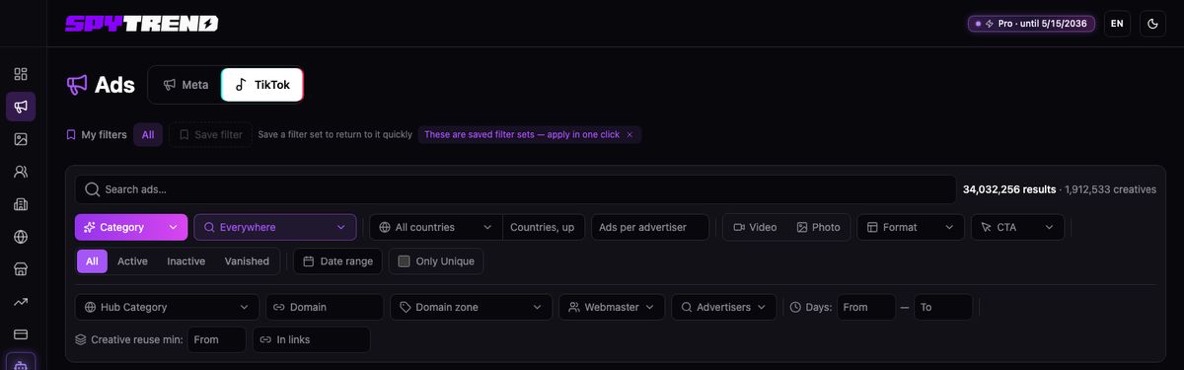
One thing deserves a separate note, because older reviews keep getting it wrong: Spytrend is no longer Meta-only. The Ads, Webmasters and Websites sections carry a Meta / TikTok source switch, and the TikTok tab is not a placeholder: at the time of our check it returned 34 million ads and 1.9 million creatives with live statuses and current dates. In other words, the same filter set and the same webmaster grouping work across both platforms without a second subscription.

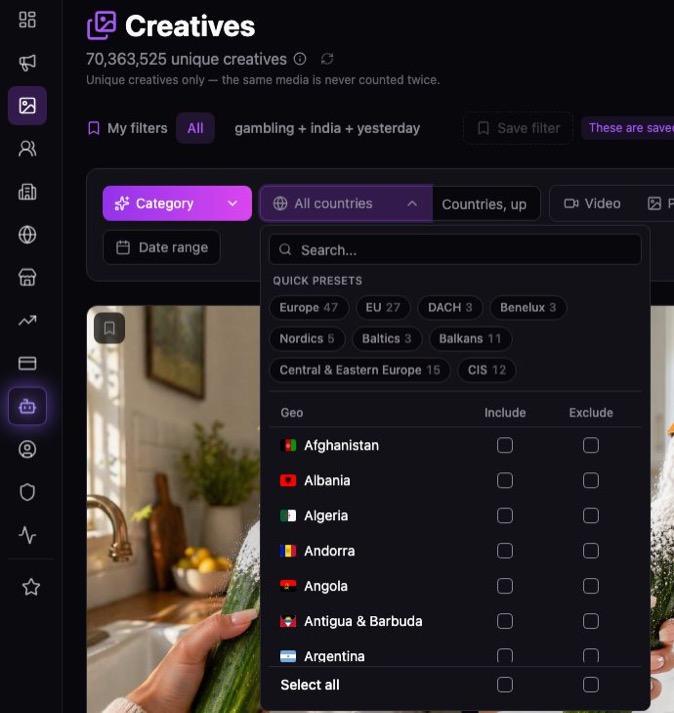
The main difference from the other six is grouping by webmaster: ads are stitched together by four identifiers (pixel, domain, Page ID and IP), so one profile assembles everything a competitor runs — pages, domains and funnels under the same owner — instead of the lone banner a keyword search would have caught. A country filter exists in every section — 193 countries in the list, and in Creatives and Advertisers you can exclude them as well as select them — while a dedicated tab in Trends shows a country-by-country market breakdown with volume, the number of active ads and average fan page lifespan; that last column tells you where moderation burns accounts fastest. Verticals are labelled by AI categorisation across 33 niches, so gambling, nutra, dating and finance are already sorted instead of being hunted with guesswork keywords. And then there is Connect to AI: the database can be plugged into an AI assistant over MCP and queried in plain words, right in the chat. No other tool in this line-up offers that.
Scorecard · average 4.6
Data freshness4.8
Geo and coverage4.5
Filter depth4.7
Vertical coverage4.4
Integrations4.4
Spytrend Ads section with the source switch set to TikTok: the counter shows 34M+ results and 1.9M creatives, with All / Active / Inactive / Vanished status filters under the search bar
The TikTok tab inside Ads: 34 million ads behind the same filter set as Meta. Figures as of August 2026.
Country picker in Spytrend Creatives with separate Include and Exclude checkboxes for each country and market presets like Europe 47, EU 27 and CIS 12
The geo popover in Creatives: countries can be excluded as well as selected. Captured August 2026.

Pros

  • Near real-time updates and a live status on every ad — fresh campaigns are visible straight away
  • Two platforms in one window: a Meta / TikTok switch in Ads, Webmasters and Websites — TikTok returns 34 million ads, not a token showcase
  • Webmaster grouping by four IDs (pixel, domain, Page ID, IP) — you see a competitor's whole network
  • AI categorisation across 33 verticals — gambling, nutra, dating and finance are already sorted
  • Seven non-overlapping sections: Ads, Creatives, Webmasters, Advertisers, Hubs, Websites, Trends
  • 193 countries in the geo filter across all sections; in Creatives and Advertisers countries can also be excluded
  • Connect to AI — plug the database into an AI assistant over MCP; the only tool of the seven that has it
  • Open pricing and a free way in: Starter at $0 with no card required, and a 7-day refund on your first payment

Cons

  • The interface is dense: there are a lot of filters, and the first half hour goes on working out how they stack together
  • We would like more ready-made tutorials — you end up assembling the basic workflows yourself, by trial and error

Who it's forMedia buyers in gambling, nutra and dating, teams running multi-geo, and anyone who would rather query creatives through an AI assistant than click through them by hand.

Try Spytrend

Affiliate link: following it may earn the desk a commission, and it does not affect the ranking (methodology).

Tyver

4.3/ 5.0

A young spy tool with strong Facebook coverage for the RU market and modern filters.

Tyver is the most visible newcomer of recent seasons and the only tool here that genuinely competes with the leader on Facebook in the Russian-speaking market. The interface was clearly built this decade: filters combine properly, results are readable, and nothing has to be forced by hand. If all your traffic lives on Facebook and runs to RU/CIS, Tyver will do the job.

The problem is elsewhere — the tool has not built a reputation yet. We could not find a public review profile for it — not on Trustpilot, not on the industry platforms — and that is not “few good ones”, it is almost nothing to verify. For a tool you hand money to and lean on for buying decisions, a review history is not a formality. On top of that, there is little to look at in Tyver outside Facebook.

Scorecard · average 4.3
Data freshness4.6
Geo and coverage3.9
Filter depth4.5
Vertical coverage4.3
Integrations4.2

Pros

  • Strong Facebook coverage aimed specifically at the RU market
  • Modern interface with flexible, combinable filters
  • Moving fast: features arrive in noticeable steps

Cons

  • No public review profile that we could find — there is no reputation to check
  • Expensive relative to the coverage it delivers
  • Coverage outside Facebook is weak
  • No AI assistant integration and no meaningful automation

Who it's forFB buyers on RU/CIS who need one strong Facebook source and do not need other platforms.

Full review

Minea

4.1/ 5.0

The best e-commerce and dropshipping tool in this line-up, and the weakest on grey verticals.

Minea is built around the product rather than around the ad: next to a creative you see the product itself, the store, and how the whole funnel is put together. In our testing it covered Facebook, TikTok and Pinterest, and it comes with tutorials, so a newcomer to physical products has an easier entry here than with any other tool on this list. Its public Trustpilot rating is 3.8 out of 5 across 326 reviews, checked on 4 August 2026 — the highest in this line-up — and the team replies to most negative reviews in public, which is rare on this market and a good sign.

But an affiliate working outside e-commerce will not get much from Minea. Gambling, betting and nutra are treated as afterthoughts: there is no labelling for them, so you search by hand. Add the credit model — revealing products and stores burns through your allowance, and on an active week it runs out well before the month does.

Scorecard · average 4.1
Data freshness4.3
Geo and coverage4.2
Filter depth4.0
Vertical coverage3.6
Integrations4.4

Pros

  • The strongest e-commerce and dropshipping tool in this line-up
  • Facebook, TikTok and Pinterest in one window, plus a product showcase
  • Trustpilot 3.8 across 326 reviews as of 4 August 2026 — the best public rating here, and the team answers negative reviews
  • Plenty of tutorials for getting into physical products

Cons

  • In our testing gambling, betting and nutra were not labelled — not usable for grey verticals
  • Credit model: revealing products and stores runs into your plan's limits
  • No Russian-language interface or support

Who it's forProduct and dropshipping buyers on Western geos, and anyone hunting for the product rather than just the creative.

Full review

AdHeart

4.0/ 5.0

A veteran of the RU scene with a big Facebook database and a last-generation interface.

Everyone who came into affiliate marketing through Facebook knows AdHeart: it has been around for years, the ad database is large and the entry price is low. Its reputation is checkable, too — Partnerkin has accumulated 16 reviews averaging 7.3 out of 10, and it is a rare case where there is something to read before you pay, rather than promo posts only.

The price of that accessibility is age. The interface looks and behaves like a tool from the previous generation, the filters are simpler than the leaders', and refresh speed drifts: sometimes today's data, sometimes a noticeable lag. There is nothing to look at outside Facebook. As an inexpensive working tool for FB it still holds up; as your only spy tool in 2026, it no longer does.

Scorecard · average 4.0
Data freshness4.0
Geo and coverage3.9
Filter depth4.1
Vertical coverage4.2
Integrations3.8

Pros

  • A large archive of Facebook ads
  • Checkable reputation: 16 reviews on Partnerkin, averaging 7.3/10
  • Cheap entry — works as a first paid spy tool

Cons

  • Dated interface: navigation and filters lag behind the leaders
  • Refresh speed is inconsistent
  • Facebook only — there are effectively no other platforms

Who it's forAnyone who needs a cheap FB spy tool and does not care about a modern interface.

Full review

AdSpy

3.6/ 5.0

A huge historical Facebook and Instagram archive at a price that no longer looks justified.

AdSpy is a market veteran, and its strength has not changed: a historical archive of Facebook and Instagram ads built up over years, plus deep search — by ad text, by comments, by affiliate links. If the task sounds like “find what was running in this niche two years ago”, AdSpy handles it better than most.

Everything else works against it. A single plan starting at $149 a month with no lower tier is the most expensive entry in this line-up; the figure comes from the comparison table on Spytrend's site (August 2026), which makes it a vendor's claim about a competitor, so check the current price on the AdSpy site. The interface has gone so long without an update that you notice on the first screen. And most importantly: Trustpilot 2.4 out of 5 as of 4 August 2026 — one of the three worst public ratings here, with only BigSpy and Dropispy below it, and complaints centred on support and refunds. There are only eight reviews, so the sample is small, but its tone is consistent. A gap that wide between price and satisfaction is not something to wave away.

Scorecard · average 3.6
Data freshness3.2
Geo and coverage4.0
Filter depth3.9
Vertical coverage3.7
Integrations3.2

Pros

  • One of the largest historical archives of Facebook and Instagram ads
  • Deep search: by text, by comments and by affiliate links
  • Stable for many years — the tool is not going anywhere

Cons

  • The most expensive way in here: a single plan with no entry tier
  • Trustpilot 2.4 as of 4 August 2026 — one of the three worst ratings here, at the highest price
  • The interface is showing its age
  • Recurring complaints about support and refunds

Who it's forAnyone who specifically needs archive depth on Facebook and Instagram and is willing to pay full price for it.

Full review

BigSpy

3.2/ 5.0

Cheap and broad on platforms, with a reputation problem around billing.

BigSpy competes on breadth and price: Facebook, Instagram, TikTok, YouTube and Twitter in one interface, a free tier to look around, and low prices on the paid plans. As a way to see what a spy tool is for the first time without paying a hundred dollars for the privilege, it works.

Then the caveats start. The public Trustpilot rating is 2.1 out of 5 across 25 reviews, checked on 4 August 2026 — the lowest here — and a noticeable share of the negativity in the Trustpilot reviews themselves is about one thing: auto-renewal and a charge after the free trial that users did not expect. That is not a nitpick about the interface, it is a question about how billing is set up — so if you take the trial, set yourself a cancellation reminder. The data is uneven too: duplicates show up in results and the filters are shallow.

Scorecard · average 3.2
Data freshness3.0
Geo and coverage3.6
Filter depth3.1
Vertical coverage3.3
Integrations3.0

Pros

  • The lowest barrier to entry: there is a free tier
  • Many platforms at once — FB, IG, TikTok, YouTube, Twitter
  • Good enough for understanding what spy tools do without spending much

Cons

  • A wall of complaints about auto-renewal and post-trial charges in the Trustpilot reviews — the tool's main risk
  • Trustpilot 2.1 as of 4 August 2026 — the lowest rating here; data quality and deduplication are uneven
  • Shallow filters — you will not get a deep analysis out of it

Who it's forBeginners taking a first look at spy tools — with the trial end date firmly in your calendar.

Full review

Dropispy

3.0/ 5.0

A cheap, narrowly specialised dropshipping tool — and nothing beyond that.

Dropispy solves one problem: seeing which products dropshippers are running on Facebook right now. There is a free tier, the paid plans are inexpensive, and the product showcase is easy to read. Within its niche the tool honestly earns its money.

Outside dropshipping there is nothing to take: one platform, narrow geos, and no grey verticals surfaced in our testing. The public Trustpilot rating is 2.3 out of 5 across 38 reviews, checked on 4 August 2026, and the complaints follow a familiar script: trouble cancelling the subscription and unexpected charges. For an affiliate this is a supplement to a main spy tool rather than a choice in its own right.

Scorecard · average 3.0
Data freshness3.0
Geo and coverage3.2
Filter depth3.0
Vertical coverage2.6
Integrations3.2

Pros

  • Cheap, with a free tier for looking around
  • A clear product showcase for Facebook dropshipping
  • Simple interface — there is almost nothing to learn

Cons

  • Very narrow specialisation: outside e-commerce there is nothing here for an affiliate
  • Trustpilot 2.3 as of 4 August 2026; recurring complaints about billing and cancellation
  • One platform and narrow geo coverage

Who it's forDropshippers, as a side tool next to a main spy service.

Full review
04 — Verdict

Why Spytrend came first

Three things pulled the tool to the top. None of them is about a pretty interface — all three change how a media buyer's working day goes.

01

Connect to AI — the only integration of its kind here

The Spytrend database can be plugged into an AI assistant over the MCP protocol and queried in plain words: “show me fresh gambling creatives in Brazil from the past week” — straight in the chat, without clicking through filters by hand. As of August 2026 it is the only spy tool in this line-up with that integration; the other six work only through their own interface.

02

Grey verticals are already sorted

Gambling, betting, nutra, dating and finance are part of the 33 verticals labelled by AI categorisation, and the 193-country filter is available in every section and is saved together with the rest of your filter set. On multi-geo that is the difference between “pulled the sample in a minute” and “spent an hour clearing junk markets by hand” — and in our testing Minea and Dropispy returned almost nothing on grey verticals.

03

Freshness, not archive

The data refreshes close to real time and an ad's status — active, inactive or vanished — is visible right on the card, so you spot a campaign while it is still alive. That is a fundamentally different job from archive-first tools like AdSpy: there you get depth of history, here you get today's market. For a buy you are launching tomorrow, the second one matters. The choice is deliberate and stated in the plan itself: Pro comes with 90 days of history — a tool about the current market, not about a season from two years ago.

See what's running right now

The Ads, Creatives and Trends sections answer three different questions: what is running, how it looks, and where the market has moved.

Try Spytrend

Links to Spytrend are affiliate links: following one may earn the desk a commission, and it does not affect the ranking (methodology).

05 — Fit

How do you pick a spy tool for your vertical?

There is no universal winner: a tool that digs up Brazilian casino campaigns may know nothing about dropshipping products in Germany. Here is how the ranking breaks down across the three main verticals.

01

Gambling and betting

Two things decide it here: freshness, and the ability to see who is behind a campaign. A casino creative lives for days, not months, so archive depth is useless — you need a live ad status. Second: in gambling one webmaster usually runs through a dozen domains and fan pages, and without stitching those together you are analysing fragments. Spytrend wins on both counts: webmaster grouping plus a Days Active filter that cuts everything which did not survive five days. Minea and Dropispy returned almost nothing on grey verticals in our testing — cross them off. AdSpy does return gambling data, but with a lag that is critical in this niche.

02

Nutra and dating

In nutra the value is not in a single creative but in the prelander–offer–angle combination: copying a banner is pointless if you cannot see where it leads. So you need a tool that shows landing pages and domains, not just the image. In Spytrend that is covered by pixel intelligence — the chain from ad to server — plus vertical labelling, so nutra does not get mixed in with physical products. The second workable option is AdHeart: its verticals are only partly labelled, but its database holds up on European geos. Take Tyver only if all your nutra runs to RU and CIS.

03

E-commerce and dropshipping

The one vertical where the top-ranked tool is not compulsory. In physical products what matters is not the webmaster but the product itself: how many stores are running it, at what price, on what kind of storefront. That is exactly what Minea is built for, with a product catalogue and Pinterest coverage that Spytrend does not have. If your whole workflow revolves around the product card and the store page, start with Minea. If e-com is only part of the job and there are grey verticals alongside it, one Spytrend makes more sense than two subscriptions: it covers TikTok too, its filters are stronger, and it costs less to get into.

06 — Pitfalls

Common mistakes when choosing a spy tool

Five ways subscription money gets wasted. We see all five regularly in the chats, and all five can be avoided in the ten minutes before you pay.

What goes wrong

  • Judging by database size instead of relevance. A billion ads in the database mean nothing if your particular country-plus-vertical combination returns fifty of them. What you check is not the headline number on the landing page but the results for your own query — on a free tier that takes five minutes.
  • Counting the plan price rather than the cost of the work. Most tools have add-ons on top of the base subscription: extra verticals, team seats, exports, history depth. With Spytrend it is AI categories at $50 a month beyond the first; the others have their own surcharges. Add it up for the way you will actually work, not for the pricing page.
  • Ignoring which platforms are covered. The most expensive mistake. Platform line-ups differ between tools and are barely visible on the pricing page: AdHeart and Dropispy are essentially Facebook only, AdSpy is Facebook and Instagram, Spytrend has a Meta / TikTok switch in the interface, and BigSpy and Minea each have their own mix. Check that list against your own traffic sources before you pay, not after.

What to do instead

  • Buying an annual plan before testing. The yearly discount looks sensible right up to the moment, a month in, when it turns out the database is empty on your geo. Monthly first, annual later — overpaying for one month is cheaper than a frozen year.
  • Treating a high score as proof. Ratings in this niche get gamed, visibly so. The highest score among every spy tool profile we parsed is 4.1 for PowerAdSpy, and it is also the least trustworthy: during our collection the cached version of the profile carried a Trustpilot notice saying a number of fake reviews had been removed — on the live page it had already been lifted. Regardless of that notice, the reviews themselves contain word-for-word duplicates, two different names under one identical text, and an anomalous distribution: 54 five-star ratings against 23 one-star ones, with almost nothing in between. Read the star distribution and the dates, not the average.
  • Trusting ratings with no source link. A review that hands a tool 4.9 and neither lets you open its Trustpilot profile nor names a method is selling you a click on an affiliate link. We attach sources to our numbers — and where a tool has no public rating, we write “no profile yet” instead of inventing a flattering score.
07 — Questions

Frequently asked questions about ad spy tools

On our scale, first place went to Spytrend with 4.6 out of 5. It wins on near real-time updates, grouping of ads by webmaster through pixel, domain, Page ID and IP, AI labelling across 33 verticals, coverage of both Meta and TikTok, and a connection to AI assistants over MCP that no other tool in this line-up has. Second and third are Tyver (4.3) for Facebook on the RU market and Minea (4.1) for e-commerce.

For gambling and betting, Spytrend fits: verticals are labelled by AI categorisation, so a gambling sample in the countries you need can be assembled with filters rather than guesswork keywords. Minea and Dropispy are built for physical products: in our testing they returned almost nothing on gambling and nutra.

BigSpy and Dropispy have free tiers, but they are heavily limited on the number of results and the depth of filtering — enough to understand the format, not enough to work with. Facebook's official ad library is a partial free alternative, though it has no metrics, no proper filters and no vertical data.

The spread is wide: BigSpy and Dropispy have free and cheap plans and Tyver sits at the top of the market. Per the comparison table on Spytrend's site (August 2026), AdSpy starts at $149 a month, BigSpy is $99 and AdHeart is $130 — a vendor's claim about its competitors, so check the prices on their own sites. Spytrend publishes its pricing: Starter at $0 with no card required, Pro at $79 a month, and Team from $63.20 per seat for 4–20 members, with 20% off on annual billing. When you budget, factor in AI categories: the first one is free on Pro and each additional one adds $50 a month.

Connect to AI is Spytrend's integration with AI assistants over the MCP protocol: the database connects to the assistant, and you phrase your query as ordinary text instead of configuring filters by hand. The assistant gets 20 tools and authorises through OAuth 2.1, so there is no API key to manage. Supported clients: Claude, Cursor, Codex and VS Code; ChatGPT can connect as well, provided the workspace is on a Business, Enterprise or Edu plan. The practical benefit is speed on routine work — building shortlists, comparing periods and breaking down creatives all become one question. No other tool in this ranking offers it.

For a one-off check on a specific page — yes, the ad library is free and shows active ads. For working — no: it has no vertical filters, no geo filtering at the depth you need, no run history and no data on advertisers or the funnels behind them. That difference is exactly what spy tools sell.